The cinema software space stands at an exciting yet critical crossroads. The potential for rapid innovation has never been higher but the key to unlocking it lies in how we choose to collaborate. At the recent ICTA discussion at CineEurope, Connected Cinema: Breaking Down the Software Silos Holding Our Industry Back, we identified a powerful truth: the industry’s primary technology challenges are not actually technical. Which tells me one thing; if we unite to tackle the human and commercial challenges, we open the door to boundless possibilities.
But before analysing that pathway, let’s first look how the engine is working behind the scenes.
Understanding the Engine: APIs in Cinema Software
At the heart of modern software sits a series of APIs (Application Programming Interface). Think of an API as a universal translator and secure bridge between different software platforms. In a cinema environment, your Point of Sale (POS), Theatre Management System (TMS), and screen hardware all specialise in different jobs.
When these systems use open, well-designed APIs, they talk to each other seamlessly in real-time. For example, when a ticket is sold at the POS, an open API can automatically signal the TMS to adjust lighting cues, trigger specific pre-show content, or update seat availability on digital signage displays. It turns a cluster of individual technologies into one unified, harmonious engine.
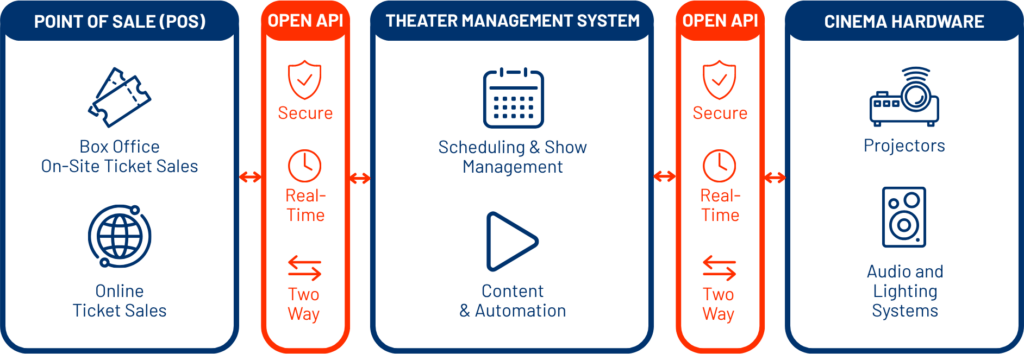
One harmonious engine.
It’s important to note that APIs do not expose anything which makes a product valuable; not the code, not the underlying logic, and certainly not a company's intellectual property. It only provides a defined channel for data exchange. Think of it like a door that makes data available to exhibitors’ chosen partners. When those vendors connect, the exhibitor they support is the one who benefits.
Moving From Silos to Synergies
When POS, TMS, advertising platforms and screen hardware fail to seamlessly communicate, we must ask ourselves, could we have done more to improve integration from the outset? Rarely are such issues down to poorly written code. Every technical hurdle can be solved, but real interoperability requires a shared responsibility.
By opening up APIs with fair, transparent models, software providers will actually multiply the value of their products, not diminish it, as those connections make them indispensable to exhibitors. In 10 years’ time when we reflect on how we evolved into a better connected community, protectionist strategies will be the ones which fell by the wayside, with openness having proved the fast-track to growth.
But opening APIs is just the beginning. Unifying our worldwide industry standards for film and release IDs offers an immediate win, creating a common language that simplifies systems integrations across international chains. These systems need to know with absolute certainty which film, specifically which release, it is handling to automate reliably. Without a common standard, cinema chains have to wrangle with competing numbering systems, adding avoidable complexity to every point of data exchange. By its nature, this is something that can only be solved at the very start of the supply chain who assign these identifiers.

Direct access to physical hardware enables deeper integrations.
At the same time, extending developer access to manufacturers’ physical hardware, either through flexible testing windows, virtual environments, or temporary loans, would ensure deeper testing and consequently friction-free deployments. And when those manufacturers develop new APIs, early communication is nearly as important as the API itself, with a sound lead time required to test and build against it.
When systems do talk to each other, the operational wins are both quantifiable and immediate. True automation, like synchronised hardware start-up and shut-down routines or playlist feature selection based on screen attributes, can save exhibitors hours of manual labour per day, while slashing energy bills and consumption.
We’ve set the stage for innovation to flourish, but pulling back the curtain requires open standards, open connectivity, and vendor flexibility. Industry bodies and neutral, mutual parties have a powerful role to play in championing this dialogue.
As technology leaders, we have an extraordinary opportunity to shape the future. Choosing collaboration over isolation will elevate our solutions, strengthen the entire cinema ecosystem, and, above all, deliver tangible value to exhibitors.

Andreas Stier,
Sales Director at OneCinema